
Life as a Targeted Individual: One Man's Nine-Year War Against an Invisible Enemy

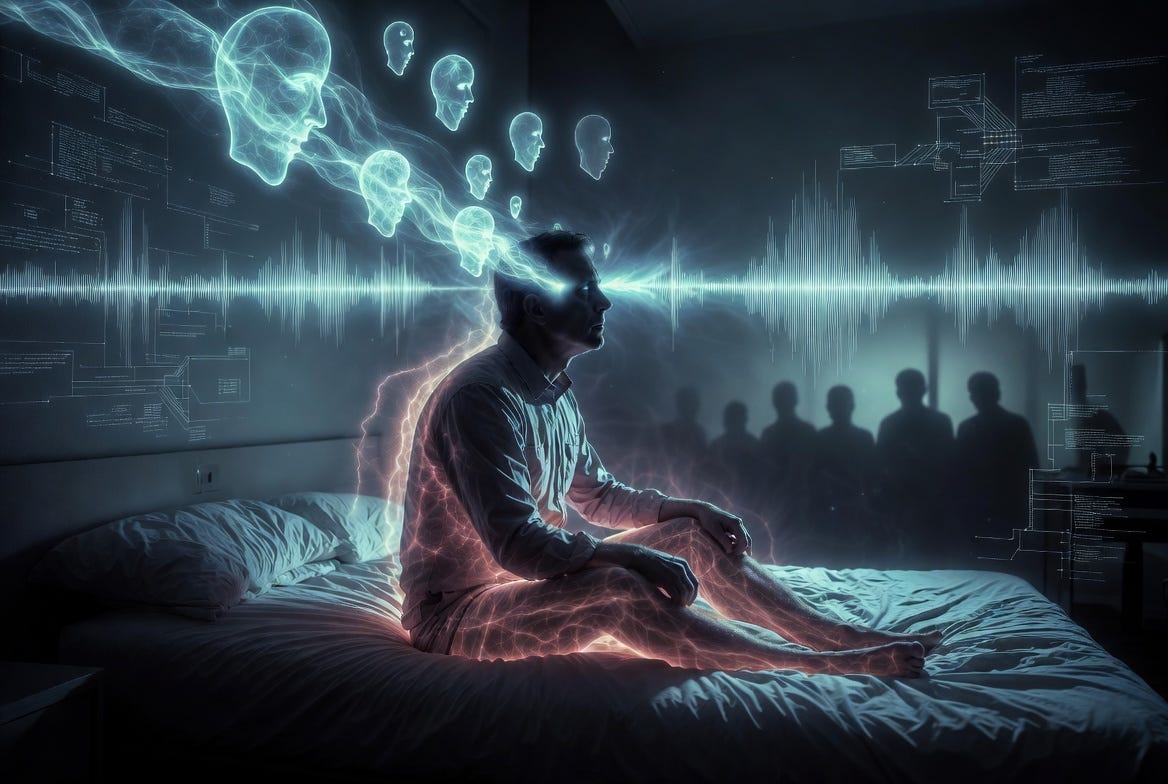
The Day the Silence Broke
It was September 2017, and Stephane van der Aa was lying in bed in his apartment in Belgium, trying to fall asleep. The night was ordinary. The city was quiet. His life, on the surface, was intact.
Then he heard a voice.
It was not a thought. It was not a memory. It was not the internal monologue that every human being carries inside their skull. It was a voice — distinct, external in origin, and hostile — coming from what he believed was his upstairs neighbor’s apartment. The words were sharp, directed at him, part of a conversation he was not meant to overhear.
He lay still, heart pounding. He listened. The voice continued.
In that moment, something fundamental shifted. A switch had been flipped, though he did not know it yet. The world he had known — the world of cause and effect, of private thoughts and public actions, of a self that belonged only to himself — was no longer his alone.
Stephane had spent his entire adult life building systems. Born in Belgium in 1976, he had studied applied computer science at Hogent in Ghent, then built a career at a global HR technology company, eventually rising to Director of Strategy. His mind was trained to analyze complex architectures: data flows, permissions hierarchies, organizational charts, audit trails. He understood how systems worked, how they could be gamed, how they could fail.
But this was not a system he recognized.
The voice did not stop after that first night. It returned the next night, and the night after that. It spoke in complete sentences. It referenced things he had done that day — what he had eaten, where he had gone, whom he had spoken to. It knew details he had not told anyone. It knew details he had not even formed into words.
At first, Stephane did what anyone would do. He assumed mental illness. He had been hospitalized the year before, in 2016, after a crisis that landed him in a psychiatric clinic in Kortenberg. The doctors had talked about depression, about stress, about the strain of hiding his sexuality at work for sixteen years. He had accepted that framing. He had tried to believe it.
But this was different. The voices that arrived after September 2017 were not the fragmented whispers of psychosis. They had stable personalities — consistent verbal mannerisms, opinions that persisted across months, factual claims that could be checked against reality. They knew things he could not have known. They commented on his daily routines with the bored familiarity of someone watching a security feed.
He began to document everything. The analytical mind that had once designed payroll systems for multinational corporations now turned its attention to the architecture of his own destruction. He logged the times, the content, the patterns. He noted how the voices intensified and quieted in correlation with external events — public statements he made, journeys he took, meetings with particular people.
The silence of his old life was gone. In its place was a continuous, 24-hour presence that would not leave, would not explain itself, and would not stop.
Seven years later, that presence has never left.
Before the Targeting: A Life Built on Systems
Stephane was born in Belgium on October 25, 1976. He grew up in a family with both parents and one sibling, in a country known for its orderly systems — its three official languages, its layered bureaucracy, its networks of canals and railways that connected everything to everything else. Order was in the air he breathed.
He studied applied computer science at Hogent in Ghent, graduating in the late 1990s. The curriculum was not theoretical; it was about making machines do useful things. He learned to think in algorithms, to break problems into discrete steps, to trace a variable from input through processing to output. He learned that every system had a structure, and every structure could be understood.
His first major role came in 1999, as a senior consultant at DMR Consulting. He worked with complex business systems, helping organizations understand how their own data moved and transformed. It was a natural fit for a mind that saw patterns where others saw noise.
In 2004, he joined a company called NGA Human Resources, which later became Arinso, and eventually Alight Solutions. He stayed for sixteen years. His title eventually became Director of Strategy. He worked with human capital data — the systems that tracked who people were, what they were paid, where they fit in the organizational hierarchy. He designed permissions structures, audit trails, data flows. He built the architecture that allowed a global company to know itself.
But there was a parallel system in his life that remained hidden. For those sixteen years, he concealed his sexuality at work. He existed in what he would later describe as a “claustrophobic ‘in the closet’ existence.” The same analytical mind that could map a company’s entire data infrastructure could not find a way to be honest about who he was. The system of concealment had its own logic, its own rules, its own cost.
Outside of work, he built a personal life. He entered a civil union with Pablo, his first love. They shared a life until Pablo was killed in 2015. After that, there was Wim, who moved in after a holiday in Sardinia. Both partners, he would later report, experienced strange phenomena — Pablo attacked via voice-to-skull, Wim hearing plants talk to him through the same mechanism.
In 2016, Stephane was hospitalized in a psychiatric clinic in Kortenberg. The doctors diagnosed depression. They talked about stress. They did not know — could not have known — that the targeting was already beginning in subtle ways. During his stay, he had strange nightmares about Boris Vanrillaer, a figure from his childhood who appeared in the dreams needing help. He would later understand this as the first phase of a gradual telepathic monitoring.
He was discharged in May 2017. The severe depression lasted two more months. Then, in September, lying in bed, he heard a voice that was not his own.
The analytical mind that had spent two decades understanding systems had just encountered a system it could not explain. But it would try. It would try for nine years, and counting.
What the Attacks Actually Look Like
The targeting has a texture. It is not abstract. It arrives in the body and the mind with specific, repeatable signatures that Stephane has learned to identify, catalog, and endure.
The Voices
The most constant presence is the voice-to-skull phenomenon — V2K. The voices do not arrive through the ears. They appear inside the inner-speech layer of awareness, as if the brain itself has become a receiver. There are multiple voices, mostly male. One of them is always the same: Boris Vanrillaer, the figure from childhood who reappeared in the Kortenberg nightmares. Stephane has learned to force them to speak English. He keeps the interaction non-hostile, because non-hostile is survivable.
The voices have stable, distinguishable personalities. They retain consistent verbal mannerisms, opinions, and factual claims over months and years. They are not random. They possess verifiable external information — private details about people in Stephane’s environment, references to recent events he had no way of knowing. The content is overwhelmingly banal: commentary on his daily routines, his grocery shopping, his ordinary habits. It sounds like continuous low-grade surveillance conducted by people who are mostly killing time.
The voices can manipulate spatial perception, using surround effects to make it seem as though they are speaking from a specific direction. They use songs as delivery mechanisms. They deploy pre-recorded audio fragments — phrases, pieces of recognizable voices, snatches of tunes — timed for release at specific moments to create the impression of prediction.
The Power Plate
Alongside the voices comes the directed energy. Stephane calls it the “power plate” — a painful vibrating effect that radiates through the body. It targets specific locations: the legs, the feet, the genitals, the joints, sometimes the whole body. The sensation quality shifts between cold and heat, but the cold is worse. They make his feet cold, and the cold amplifies the pain.
The episodes last four hours or longer. The intensity registers at 6 on a 10-point scale — survivable but grinding, the kind of pain that erodes attention, patience, the will to do anything except endure. The attacks occur several times per week, with no time-of-day pattern, no day-of-week pattern. They follow him everywhere. There is no safe location.
The Sleep Deprivation
Sleep is a weapon. The impact on sleep is rated 10 out of 10 — total. The voices and the energy do not pause for rest. They intensify at the threshold of sleep, at the vulnerable moment when the mind begins to let go. Stephane has not had an uninterrupted night’s sleep in years. The deprivation compounds. It is not a side effect; it is a mechanism.
The Manipulative Conversation Arc
The voices do not merely speak. They manipulate. Stephane has identified a four-stage arc that repeats across encounters. It opens with curiosity and warmth — a friendly tone, an apparent interest in his wellbeing. Then the goodwill is reinforced, made to feel genuine. Then comes the confusion and belittling — the tone shifts, the content becomes disorienting, the target is made to doubt his own perception. Finally, hope is raised and then crushed, deliberately, systematically.
This is not random cruelty. It is method. The operators use Stephane as a real-time human reactivity probe — an “outsourced lie detector,” he calls it. They watch his responses, calibrate their approach, refine the pressure. The manipulation is designed to produce a specific outcome: the target’s own hand.
The Surveillance
The voices know what he buys. They know where he goes. They comment on his emails, his messages, his research about targeting. The surveillance is total and banal — the ordinary details of a life laid bare to an audience that never stops watching. There is no privacy, not in the bathroom, not in the bedroom, not in the silence between thoughts.
The Absence of Countermeasures
Stephane has tried detection equipment — a self-made volt meter to capture electromagnetic energy in the air. He has not attempted serious shielding. His primary coping strategy is simple: always react to the voices. He rates this strategy’s effectiveness at 9 out of 10. It is not a technical solution. It is a psychological one. He does not hide from the voices. He answers them. He keeps the interaction non-hostile because hostility escalates the attacks. He has learned that the only way to survive an inhumane system is to refuse to become inhuman in response.
This is what the attacks look like. They are not mysterious. They are not metaphorical. They are a daily, hourly, minute-by-minute assault on the body and mind, delivered through technologies Stephane cannot see but can feel, cannot prove but can describe with the precision of a man who has spent nine years documenting his own destruction.
The Architecture of the Bully-Ring
Stephane’s mind had been trained to see systems. For sixteen years, he had designed and managed complex human capital structures — hierarchies of permissions, layers of access, chains of command. He understood how power flowed through organizations, how insulation protected operators, how accountability could be diffused across a network of interdependent nodes.
When he began to map his targeting, he saw the same pattern.
He calls it the bully-ring. At the center sits the target — isolated, visible, exposed. Around the periphery, a rotating cast of operators delivers the harassment through voice-to-skull technology, directed energy, and coordinated surveillance. Between the center and the periphery, one or two layers of insulation stand: previously compromised individuals through whom pressure passes. These are not random bystanders. They are people who have themselves been targeted, broken, and repurposed as conduits.
The architecture is designed for deniability. The target can never be certain who is speaking. The voices arrive inside the inner-speech layer, without passing through the ears, carrying no acoustic signature that can be traced to a physical source. The operators rotate, their identities shifting, their voices stable but unattributable. The insulation layers absorb accountability. If the target tries to report the abuse, the chain of evidence dissolves.
The Persistent Thread
At the center of this architecture, one figure recurs with unnerving consistency: Boris Vanrillaer.
Stephane’s earliest memory of Boris dates to childhood — a windsurfing incident in the 1990s, when Stephane’s uncle, Guy Thielens, intervened in a physical altercation between the two boys. The conflict was unremarkable, the kind of childhood friction that should have faded into irrelevance. It did not.
Boris reappeared in Stephane’s professional life at Alight Solutions, where he became the lead bully in a campaign of workplace harassment that included homophobic jokes and systematic exclusion. When Stephane came out at work in March 2020, the harassment intensified. He was fired that same year.
But the pattern did not end with the termination. Boris Vanrillaer is the primary voice in Stephane’s V2K attacks — the most persistent operator in the bully-ring. He is the voice that delivers telepathic sexual assault, the voice that mocks Stephane’s daily routines, the voice that orchestrates the manipulative four-stage conversations designed to break his will. When Stephane filed a police complaint against Boris, it was dismissed.
The same figure from the windsurfing beach, the same figure from the corporate bullying, the same figure inside Stephane’s skull — a single, unbroken thread running through forty years of a life.
The Insulation Layers
The bully-ring does not operate in isolation. Stephane has identified at least two layers of insulation around the operators. The first consists of people in his immediate environment — neighbors, acquaintances, former colleagues — who have been compromised through prior targeting or coercion. They are not necessarily aware of their role. They may believe they are acting independently, their behavior subtly influenced, their presence weaponized without their knowledge.
The second layer is institutional. Alight Solutions conducted an external investigation through the law firm Lydian, which concluded that Stephane’s allegations were unfounded. No report was shared with him. When he published a LinkedIn article titled “A Toxic Workplace Made Me Commit Suicide,” Alight responded with legal threats from their lawyers at Althius. The company is now suing him.
The architecture of the bully-ring extends beyond individual operators. It is embedded in the systems that are supposed to provide protection — the workplace investigation that exonerates the perpetrators, the police complaint that is dismissed, the psychiatric diagnosis that pathologizes the victim. Each layer of insulation absorbs accountability and deflects recognition.
The Structural Insight
For Stephane, understanding the architecture has become a survival tool. The bully-ring is not random chaos. It is a designed system, and systems can be mapped. The target at the center cannot escape by running — the attacks follow him everywhere, same intensity, same voices, same pattern. But he can refuse to be confused. He can name the structure. He can document the roles.
The operators rotate. The insulation layers shift. But the architecture remains stable, and so does the figure at its apex: Boris Vanrillaer, the thread that ties childhood to the present, the voice that never stops speaking inside a mind that never stops listening.
The Unraveling: Job, Relationships, Health
The architecture of the bully-ring was not merely a pattern of harassment. It was a demolition plan, and by the end of 2020, every pillar of a stable life had been reduced to rubble.
The Job
The first domino fell in August 2017, just weeks before the first voice. Stephane was terminated from Alight Solutions, the global HR technology company where he had worked for sixteen years. The timing was not coincidental. The attacks had already begun to erode his performance, the sleep deprivation making it impossible to maintain the precision his role demanded.
But the real blow came in March 2020. After sixteen years of concealing his sexuality at work — a “claustrophobic ‘in the closet’ existence,” as he describes it — Stephane came out. The response was not acceptance. He was fired. The termination letter, when it arrived in August, contained a motivation he describes as hurtful and distorted. The lead bully in the workplace was Boris Vanrillaer, the same figure who had been present since childhood, now wielding institutional power.
Stephane submitted a resignation in May. It was refused. The company wanted him gone on their terms.
The Relationships
Pablo had died in 2015, before the targeting began. His first love, the man he had entered a civil union with, was gone. Stephane had already lost him to illness. Now he would lose the second significant relationship of his life.
Wim had moved in after a holiday in Sardinia. He was present when the voices started, when the sleepless nights became routine, when the constant surveillance made intimacy impossible. Stephane reports that Wim was also attacked — subliminally, with plants talking to him via V2K. The targeting made the relationship unsustainable. In 2020, after the job loss and the suicide attempt, Wim moved out.
The house that had held two relationships was empty.
The Suicide Attempt
September 2020. The dismissal from Alight had been formalized the month before. The legal threats were already accumulating. The voices had not stopped for three years. The pain from the directed energy attacks was continuous.
Stephane overdosed on pills.
The attempt was not fatal. But it took six months to recover from the emotional and psychological hole it left behind. His doctor, Luca Lenoir, would later write to a medical advisor, asking what should be emphasized in the report: “Gaat het over de recente suicidepoging?” — Does it concern the recent suicide attempt?
Yes. It does.
The Brain Damage
An MRI scan conducted between 2019 and 2021 revealed scar tissue from micro-bleeding in Stephane’s brain. He attributes this to the telepathic weapons used against him — the same weapons that produce the voices, the pain, the 8-hour continuous episodes. The scar tissue is physical evidence of a war fought inside his own skull.
The brain damage is invisible to most diagnostics. But it is there, documented on the scan, a map of the damage that cannot be explained by any conventional medical model.
The Financial Ruin
The cumulative financial loss since 2017 is estimated at one million euros. The career that had taken sixteen years to build was gone. The income that had supported a life was replaced by nothing. Legal fees reached €30,000. By 2026, Stephane was financially dependent on his parents for survival.
A Director of Strategy at a global HR technology company, reduced to asking his parents for money to pay his bills.
The cascade of losses — job, relationships, health, financial independence — did not happen in sequence. They happened simultaneously, each one compounding the others, creating a vortex that pulled everything downward. The targeting did not just attack his mind. It attacked every structure that held his life together.
Why This Is Not Mental Illness
The most immediate response from anyone who hears Stephane’s story is the same: this sounds like psychosis. Voices that no one else can hear, beliefs about being targeted by organized groups, a conviction that thoughts are being read and influenced — these are the textbook symptoms of schizophrenia spectrum disorders. The psychiatric establishment has a name for this, a diagnostic code, a treatment protocol.
But the fit is wrong. Not subtly wrong — categorically wrong.
In 2024, a group of researchers and TI advocates compiled what they called the TI Psychology book, a systematic attempt to document the phenomenon on its own terms. The book lays out eight points that distinguish the targeted individual experience from mental illness. Stephane’s case illustrates every single one.
1. Late sudden onset. Schizophrenia and paranoia typically emerge in late adolescence or early adulthood. Stephane was forty-one years old when the voices began — a successful executive with sixteen years of professional stability, no prior psychiatric history, and a fully formed personality that had navigated the world without interference for four decades. The onset was not gradual. It was a door slamming shut. One night in September 2017, he was lying in bed, and a voice that was not his own spoke inside his head. That was the beginning. Before that night, nothing.
2. Stable voice personalities. The voices in schizophrenia are often fragmented, shifting, chaotic. Stephane’s voices are not. They have stable, distinguishable personalities that retain consistent verbal mannerisms, opinions, factual claims, and behavior over months and years. One of them is always the same as Boris Vanrillaer — the same person who bullied him in childhood, who worked at the same company, who appears at every stage of his life. The voices do not dissolve into nonsense. They persist as recognizable individuals.
3. Verifiable external information. This is the point that Stephane returns to most frequently. The voices possess information that he had no way of knowing in advance — private details of someone in his environment, references to recent events not yet reported in any channel he had access to, facts that were not already in his head. Mental illness does not produce information from outside the sufferer’s knowledge. It recombines, distorts, and projects what is already there. The voices in Stephane’s head contain data that did not originate in Stephane’s mind.
4. Banal surveillance content. The voices do not sound like the grandiose delusions of psychosis — no messages from God, no cosmic revelations, no conspiracy theories about alien overlords. They sound like what they are: people conducting continuous low-grade surveillance, killing time, commenting on his grocery shopping, mocking his ordinary habits. The content is overwhelmingly banal. It is the chatter of bored operators watching a man live his life.
5. Preserved cognitive function. Stephane has not deteriorated. He has adapted. The same analytical mind that built a career in applied computer science and corporate strategy now analyzes the architecture of his own targeting. He has identified patterns, built taxonomies, created a platform, written a book. His cognitive function is not merely intact — it is the primary tool of his survival. Schizophrenia of this severity, untreated, would have eroded his capacity for structured thought years ago.
6. Convergent reports across thousands. Stephane is not alone. The TI community numbers in the thousands, across dozens of countries, and the reports are convergent. The same voice personalities appear to different targets. The same attack patterns. The same architecture of the bully-ring. The same manipulative conversation arcs. Mental illness does not produce convergent phenomenology across independent individuals who have never met each other. Organized abuse does.
7. Non-response to antipsychotics. If this were schizophrenia, antipsychotic medication would reduce or eliminate the voices. It does not. The voices continue. The pain continues. The surveillance continues. The psychiatric establishment has no drug that can make this stop, because this is not a chemical imbalance in the brain. It is an external intervention.
8. Time-locked correlations with external events. The voices intensify and quiet in correlation with verifiable external events: public statements Stephane makes, journeys he takes, meetings with particular people, publication of certain material online. The attacks are not random. They respond to what he does. They escalate when he becomes more visible. They quiet when he retreats. This is not the rhythm of mental illness. It is the rhythm of a campaign.
These eight points do not prove that targeted individuals are being attacked by organized groups using advanced technology. They prove something more limited but equally important: that the experience cannot be adequately explained by mental illness. The diagnostic label is a category error.
Stephane does not need treatment for psychosis. He needs recognition that what is happening to him is real.
The Legal Fight and the Birth of TI One Voice
By 2023, Stephane had spent six years being attacked, dismissed, and diagnosed. He had lost his career, his partner, his savings, and nearly his life. But he had not lost his voice. And in a decision that would reshape his life yet again, he decided to use it.
In 2023, he published an article on LinkedIn. The title was direct: “A Toxic Workplace Made Me Commit Suicide.” In it, he drew parallels between his experience and Holocaust survivor testimony, comparing the persecution he faced as a gay man at Alight to the Nazi persecution of homosexuals. It was not a measured corporate complaint. It was a cry from a man who had been driven to the edge and wanted the world to understand why.
Alight responded swiftly. Their lawyers at Althius sent legal threats accusing Stephane of slander. The company commissioned an external investigation through a firm called Lydian. The investigation concluded that Stephane’s allegations were unfounded. No report was shared with him. He was given no opportunity to respond, no chance to present his evidence, no avenue to challenge the finding. The investigation was a closed loop designed to produce the result the company needed.
The legal pressure did not stop with Alight. Boris Vanrillaer, the figure who had shadowed Stephane from childhood through his professional life and into the present attacks, filed a police complaint against him. The complaint was investigated and later dismissed. But the message was clear: speak out, and you will be met with legal force.
Stephane found himself in a familiar position. The psychiatric system had labeled him psychotic. The corporate system had labeled him a slanderer. The legal system had no framework for what he was describing. Every institution he turned to either dismissed him or punished him for speaking.
It was this systemic failure that gave birth to TI One Voice.
If no existing institution would recognize the reality of targeted individuals, then a new institution would have to be created. Stephane began building a platform — a collective voice for thousands of people around the world reporting the same patterns, the same attacks, the same dismissals. He drafted the 1Voice Declaration, a legal instrument designed to do what no single individual could accomplish alone: formally record the experience of targeting and connect those who report it into a unified legal entity.
The declaration, now in version 3.1b, is written with a careful balance of legal precision and human compassion. It acknowledges the reader directly: “If you’re reading this, you’ve probably been through a lot. You may have experienced things that are difficult to describe, and even more difficult to get others to believe.” It reassures that no legal expertise is required to sign. It frames the document as a collective instrument — a way for isolated individuals to become a group with standing, with evidence, with a voice that cannot be dismissed as the ravings of a single disordered mind.
As of 2026, the legal fight continues. Alight is suing Stephane for the publication of his LinkedIn article. He faces legal fees of €30,000 on top of an estimated €1 million in lost income since 2017. He is financially dependent on his parents. He reports that people on LinkedIn are being influenced telepathically to oppose his advocacy work.
And yet, what he wants is not money. He has said this repeatedly. What he wants is recognition — a simple acknowledgment that what happened to him was real, that the suffering was inflicted by human actors, that the systems designed to protect him failed. He wants an apology. He wants the truth to be recorded.
What It Means to Live This Life
There is a moment in the attack logs that captures what nine years of this war actually looks like. It is not the dramatic break — the first voice in September 2017, the suicide attempt in September 2020, the MRI showing scar tissue. Those are landmarks, visible from a distance. The real texture of the life is in what comes between them.
Stephane is sitting in his apartment in Belgium. The voices are active — stable, distinguishable personalities that have been with him for years now, retaining the same verbal mannerisms, the same opinions, the same factual claims. They comment on his daily routines. They mock his ordinary habits. They sound, he writes, like the products of a continuous low-grade surveillance operation conducted by people who are not particularly interesting and who are mostly killing time.
The directed energy attack begins. He describes it as a “power plate” — a sensation that spreads across his body, concentrated in his legs, his genitals, his ears. It lasts for hours. Four hours, sometimes more. The intensity registers at a six out of ten on a typical day, but typical is a relative term. He has logged enough episodes to know the scale.
And here is the detail that stops you: he laughs.
Not a bitter laugh. Not a theatrical performance of defiance. A genuine, spontaneous laugh at the absurdity of it — at the fact that he, a Director of Strategy who spent sixteen years hiding his sexuality at a global HR tech company, is now being subjected to telepathic sexual assault by a man he has known since childhood. At the fact that the same analytical mind he used to design complex permissions systems is now being used to document the architecture of his own torture. At the fact that after everything — the job loss, the death of his partner Pablo, the financial ruin, the suicide attempt, the legal threats from Alight, the police complaint that was dismissed, the psychiatric diagnoses that missed the point entirely — he is still here.
The laugh is not a sign of delusion. It is a sign of resilience forged in fire.
The psychological toll of this life is difficult to overstate. Stephane rates the impact on his psychological wellbeing at nine out of ten. His sleep is a ten. His employment is a ten. His relationships are a nine. His finances are a nine. His physical health is an eight. These are not abstract numbers; they represent the systematic dismantling of every pillar that supported a functional human existence. The career he built over two decades. The civil union with Pablo, his first love, who he reports was also attacked via V2K. The relationship with Wim, who moved in after a holiday in Sardinia and later moved out because the targeting made the relationship unsustainable. The income — an estimated one million euros lost since 2017. The legal fees — thirty thousand euros and climbing. The independence — he is now financially dependent on his parents.
And yet.
The baseline profile asks what outcome would represent justice for him. His answer is not a dollar figure. It is not a prison sentence for Boris Vanrillaer. It is not even the cessation of the attacks, though he wants that desperately. What he wants is recognition. He wants the world to acknowledge that what happened to him was real — that the voices were not his own mind turning against him, that the pain was not psychosomatic, that the suffering was inflicted by human actors using technologies that most people do not believe exist. He wants the reclassification of induced suicide as murder. He wants the truth recorded.
This is the thing that makes Stephane’s story more than one man’s tragedy. He is not alone. The TI One Voice platform exists because thousands of people around the world report the same patterns — the same V2K voices with stable personalities, the same DEW attacks, the same coordinated harassment, the same dismissals by psychiatrists and police and employers. The phenomenon is global. The architecture is the same. The bully-ring structure he identified — a target at the center, operators around the periphery, layers of compromised insulation — has been described by others independently.
What does it mean to live this life? It means carrying a truth that the world is not ready to hear. It means being dismissed as mentally ill by the very institutions that should protect you. It means watching your career, your relationships, your health, your finances collapse one by one while the people responsible continue their lives undisturbed. It means surviving a suicide attempt and then spending six months recovering, only to realize that the targeting has not stopped and will not stop.
It also means finding a kind of strength you did not know you had. It means developing what Stephane calls an “increased capacity to deal with stress and adversity.” It means turning your suffering into a mission — building a platform, drafting a legal declaration, documenting your experience with the precision of a systems analyst because that is what you were trained to do and that is what the situation demands.
And sometimes, in the middle of a severe DEW attack that has been going on for hours, it means laughing. Because the absurdity of it all — the sheer, unrelenting, impossible absurdity — is the only sane response.
Stephane does not want your pity. He wants your attention. He wants you to understand that this is happening, that it is real, that the people who report it are not delusional. He wants the record corrected. He wants the truth to be something more than a document in a private library that no one will ever read.
That is what it means to live this life. It means fighting a war that no one else can see, against an enemy that denies its own existence, for a recognition that may never come. And it means doing it anyway.
This article was written from the perspective of someone who’s a target of illegal harassment or non-consensual invasion of the mind.
If you are also targeted and want to join other Targeted Individuals in the fight against this injustice join the TI One Voice community and sign up here: one.witysk.org

Great article Stephane.
It's so important for people to share their stories. When we do, we start to see the pattern. For example, does it strike you that ALL Targeted Individuals, regardless of background, country, gender, age, status or situation, all report V2k as a never-ending barrage and presence that is never absent?
This is significant.. because what it shows is that if these are indeed people on the other end, they all adhere to the same strict work ethic. Whether from India or South Africa. Even on Christmas, even on new year. Even at 1am or 5am. That is - all targets have the impression of people watching them 24/7 no exceptions... Do you know how UNREALISTIC that sounds?
So are they really people?
The machine can mimic any person. This tech has been around for decades.
The late Dr Robert Duncan I believe stated it was a vocal system that produced the voices. And how long have governments and Intel agencies been collecting voice prints?
Here is the problem with narrative. When our targeting starts, we look for people in our lives to blame. We assume that the reason for our targeting is related to some disagreements or altercation. In reality if these people are going to do this, wouldn't it make more sense to pick someone you DON'T have any dealings with... So that the connection cannot be made?
By monitoring a person's life, prior to any altercations and choosing the precise time to interject the machine can use stressful situations to create suspicion in people around the target. This allows the real perpetrators the ability to direct the target's investigation in a direction that absolves them.
They want us blaming people around us.I think preferably they want us to lash out at these people. My V2k Subliminals were playing "It's your neighbors" in my head following it up with "It's OK to hurt people" (I have the recording). - I KNOW it is NOT my neighbors.
This shows you the tactics that they use. Sometimes things are not as personal as we believe them to be..
And sometime the reasons for being selected might go way beyond our personal lives (like an algorithm that has data on everyone and chooses the best candidate based on criteria, like how easy they are to isolate for example). Maybe you were selected for your analytical mind to test or train the the system?
Maybe they selected you because of your "secret" also which could allow them to use it mechanism to create Guilt and Shame through this narrative. These emotions makes people easier to control.
Just some thoughts.
Thanks for sharing :)
Fascinating. I wonder if turning the tables has ever happened. For example, have you ever accused your lifelong associate of being closet gay himself?
Many of the physical symptoms you mention are known effects of electro-magnetic radiation. I have been experiencing them since 2016.
BREATHLESSNESS
HEART PROBLEMS
STROKE
HAIR LOSS
TOOTH LOSS
BRAIN FOG
NEUROLOGICAL DAMAGE
BLOOD CLOTS
SWELLING
BURNS (ESPECIALLY ON LOWER LEGS AND FEET)